Milena Bonilla, An Enchanted Forest (2013-2014)
The film, An Enchanted Forest, takes as a point of departure two books with an eponymous title. The first book recounts and analyzes a discovery made by a group of scientists between 2002 and 2011. While tracking Red Deer population in the former Bohemian Forest divided between Germany and Czech Republic, the scientists noticed that the Red Deer females were not crossing the former Iron Curtain border, even though the fence has been removed since 1989. The second book narrates the story of an anarchist group called Ahornia, whose members used to gather in the same forest area. The book is a compilation of a series of statements that the secret group wrote in 1967, one year before 1968’s Prague Spring.
Milena Bonilla (1975, Bogotá, CO) graduated in visual arts at the Universidad Jorge Tadeo Lozano in Bogotá in 2000, and followed a post-academic course at the Rijksakademie in Amsterdam, in 2009-2010. Her current practice involves explorations on knowledge interpreted as a work force, and Nature as an entity colonized by language, consumed in a massive scale through images. She uses a variety of media in her produc on including installa ons, video, drawing, text, public interventions and photography.
Giorgi Tabatadze, Contemporary Forms of Desire (2017), online interface and multimedia installation
The artist will navigate us through the online interface he produced for the exhibition, Contemporary Forms of Desire. The interface brings together a collection of eclectic material – mostly audiovisual – tackling issues related to contemporary cultural production and contemporary social imaginary – its idiosyncrasies and obsessions, its implicit and explicit discourses. The collection is organised through 5 categories, 5 assemblages that provide analytical tools and conceptual coordinates that help us identify certain drives and desires of the contemporary society.
Giorgi Tabatadze (1980, Tbilisi, GA) studied sculpture at the State Academy of Arts in Tbilisi from 1997 to 2005. He 2010, he obtained a MA in Fine Arts from the Sandberg Ins tute in Amsterdam. His work mainly focuses on the image production in the contemporary society, and their circulation on both ends of the production/consumption cycle. In the Netherlands, he is a founding member of ‘Focus LAB’, an organization traveling throughout the Dutch cultural landscape, organizing meetings and group discussions around the topics of cultural production and contemporary art practices.
Vincent Hessling & Alejandro Ramírez, Double Agent (2017), lecture performance
“With this project we are laying bare the opaque dependencies of hu- mans and materials. Embarking on an open-ended expedi on through histo- ry we follow the trace of one chemical element: n, stannum, 50Sn. We track its role in the global distribu on or accumula on of wealth, we detect its func on in connec ng or overpower- ing people throughout history, and we fathom its proneness to forming alloys and alliances under di erent historical or material condi ons. On this journey beyond the Pillars of Hercules we may be subject to the fatal call of the Sirens. The outcome of our n-related exper- iment is up in the air. Tin may be the shiny thread that leads us through the labyrinth of history; but will it guide us on our way into an open future?”
Vincent Hessling (1982, Essen, DE) is a researcher at the Department of Germanic Languages at Columbia University. He focuses his interest on the the idea of progress, history of technology and science through the lenses of narratology and systems theory.
Alejandro Ramírez (1978, Bogotá, CO) is an artist and filmmaker based in Amsterdam. He holds an MA in Fine Arts from MaHKU in Utrecht Bringing together personal stories and history, which he approaches with humor and specula on, his work o en examines the way in which media, poli cal discourse and memory overlap. These strategies help to reveal the ideological machinery that underlies the way past and present events are interpreted. In his most recent works, he explores science-fiction and storytelling as tools to propel political imagination and alternative narratives.
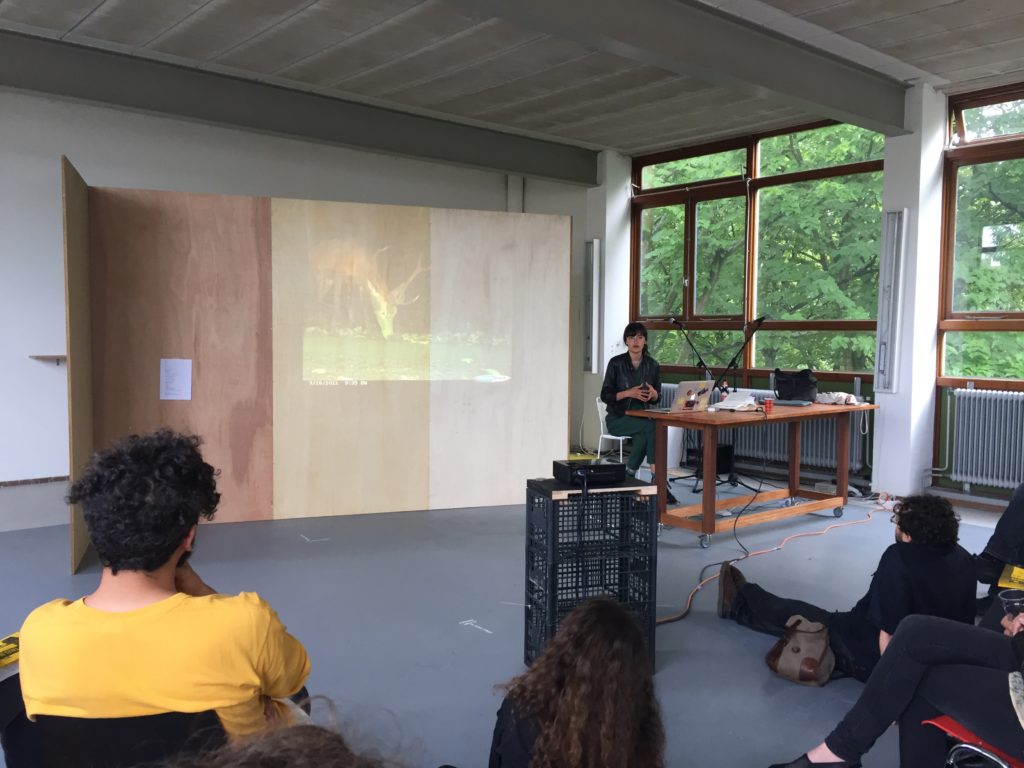 Milena Bonilla, presentation of "An Enchanted Forest". Photo: Alejandro Ramírez
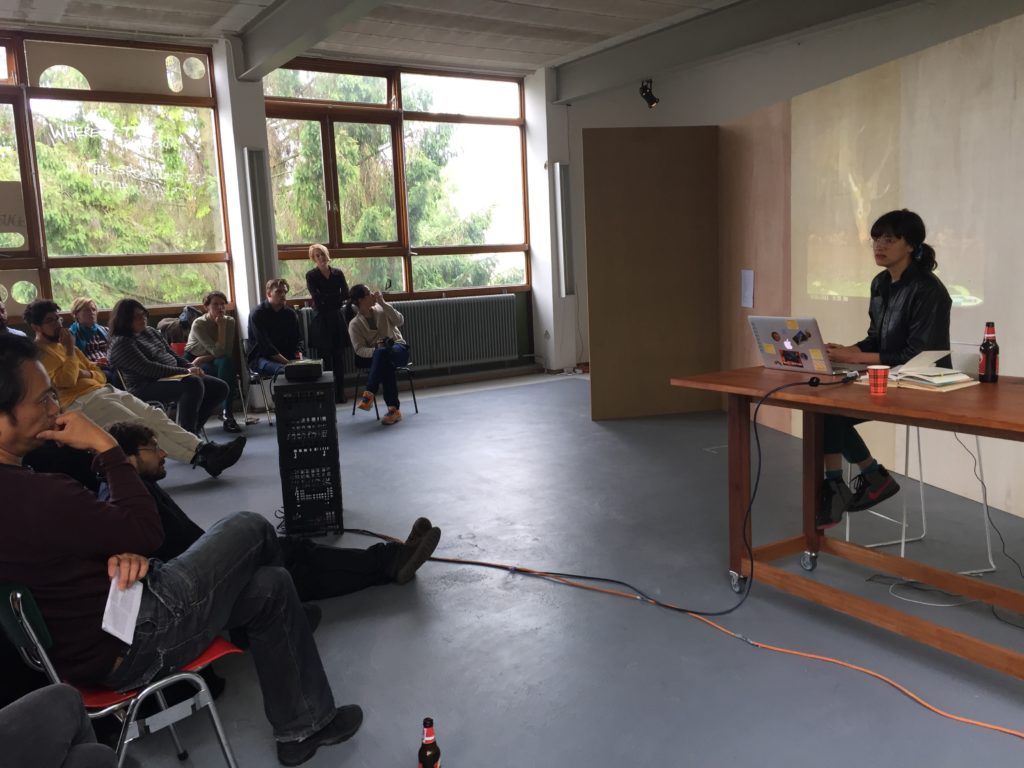 Milena Bonilla, presentation of "An Enchanted Forest". Photo: Alejandro Ramírez
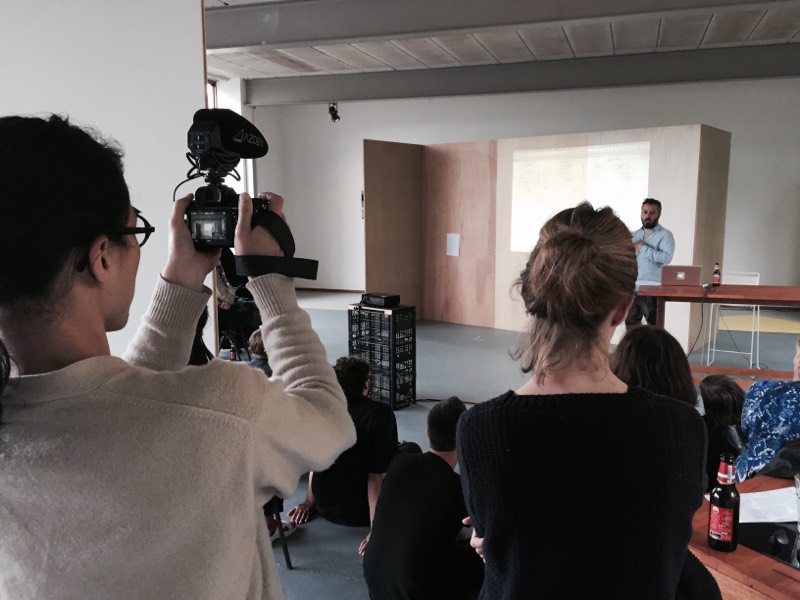 Girogi Tabatadze, presentation of "Contemporary Forms of Desire". Photo: Winston Nanlohy
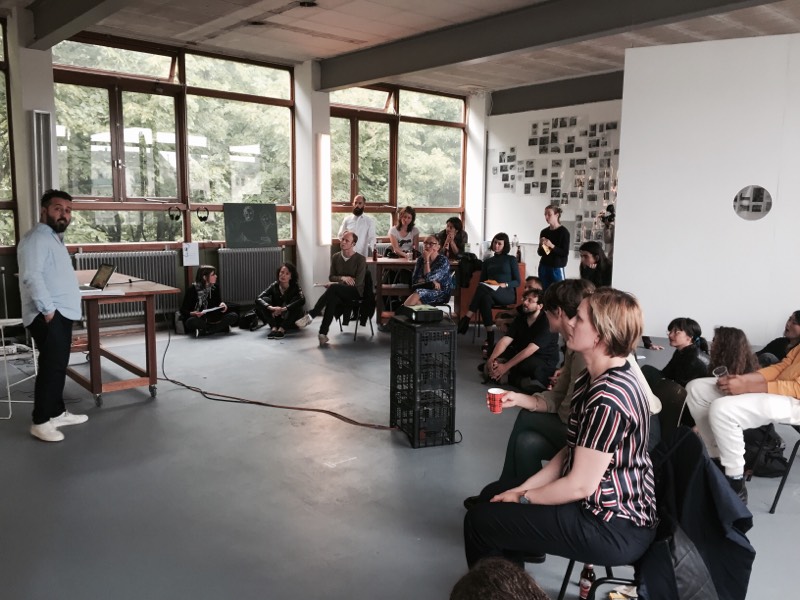 Girogi Tabatadze, presentation of "Contemporary Forms of Desire". Photo: Winston Nanlohy
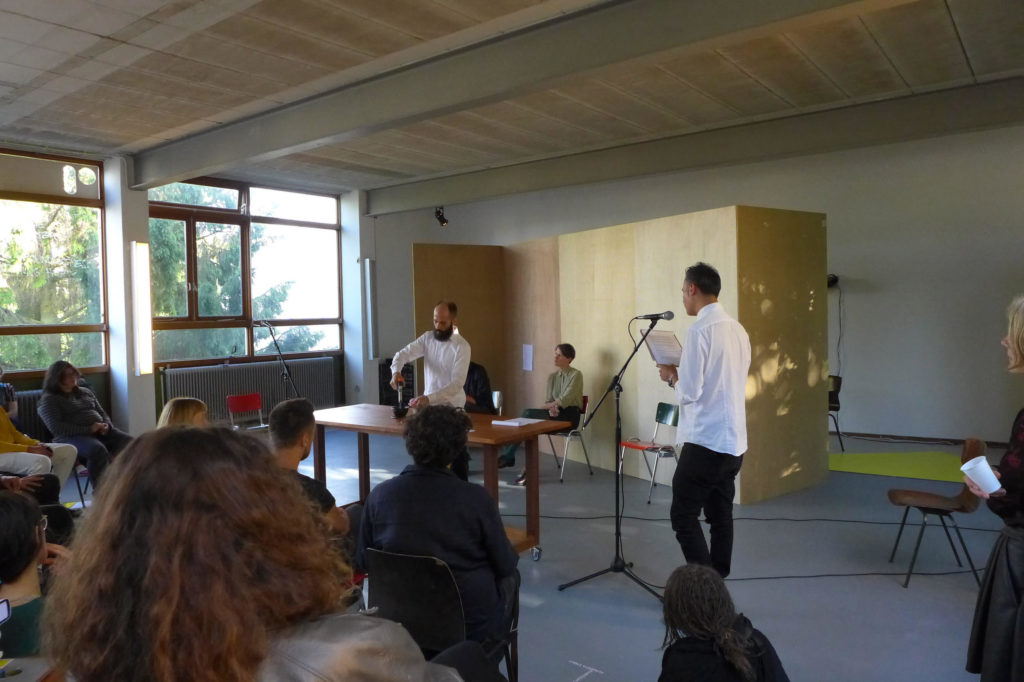 Vincent Hessling & Alejandro Ramírez, performance "Double Agent" (2017). Photo: Winston Nanlohy
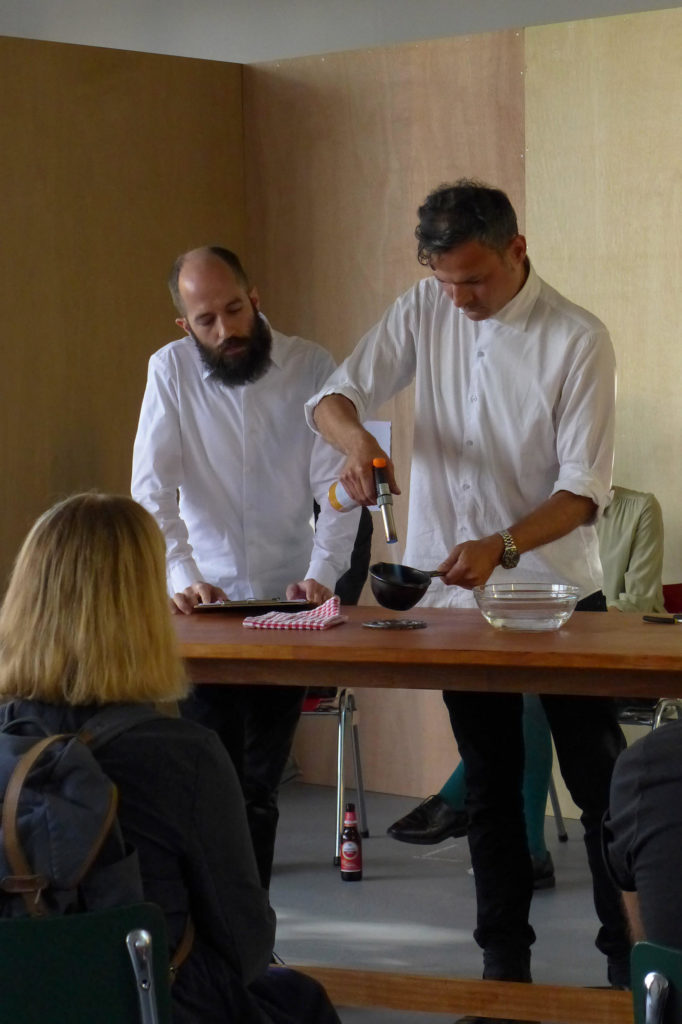 Vincent Hessling & Alejandro Ramírez, performance "Double Agent" (2017). Photo: Winston Nanlohy